
Nature Notes:
Welcome to the Sacred Earth website!

Hi there! Thanks for stopping by! My name is Kat Morgenstern, and I am delighted that you have found your way here!
I have created the Sacred Earth website as a forum for nature lovers of all stripes. Come and join me on a journey down the garden path, and off into the virtual woods, where we will explore, learn and discover all about the intertwining roots of nature and culture.
No Results Found
The page you requested could not be found. Try refining your search, or use the navigation above to locate the post.
Current issue
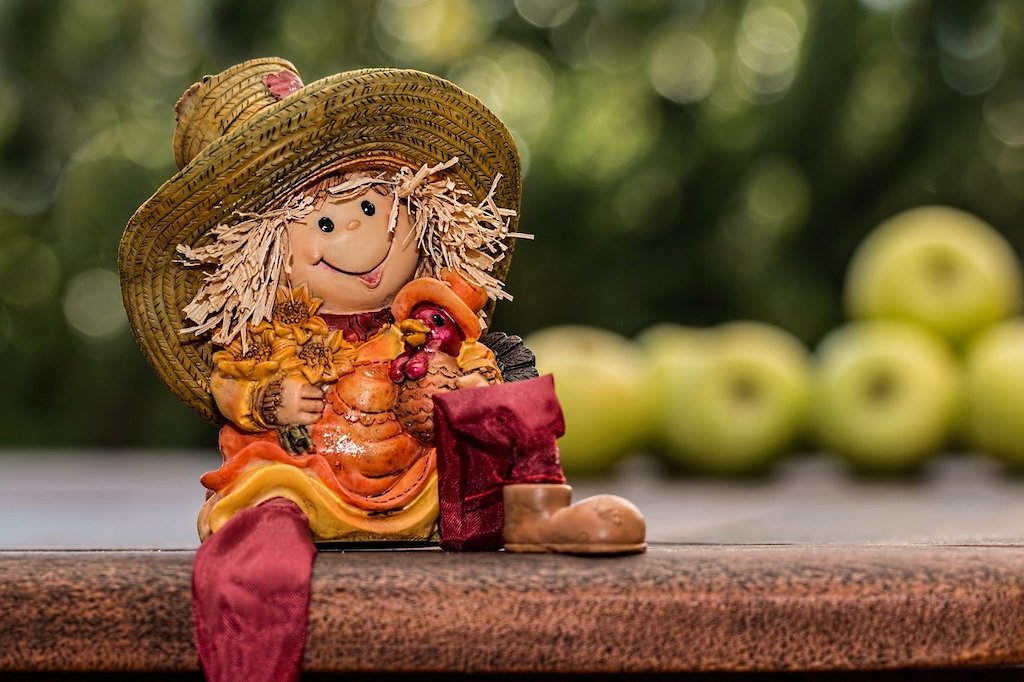
Gardening Jobs in October
Gardening Jobs in October
The summer is over, and the garden is beginning to wind down. But there are still quite a lot of gardening jobs left to do in October.
Harvesting
To begin with, you are probably still harvesting the last of your summer crops. Pumpkins, courgettes, potatoes and late runner beans, beetroots, carrots, and broccoli are still in season.
Any tomatoes that did not turn red yet don’t have to go to waste. Bring them inside and place them into a bowl with an apple or two. Cover them with a towel, and they will soon ripen.
Sowing & planting
A cold frame is a perfect place to give your peas and winter hardy broad beans an early start. Asian salad mixes and spinach make excellent winter crops that will bring an extra dash of fresh green to the dinner table.
To rejuvenate mature perennials, especially spring-flowering ones, October/November is the time to divide their roots and replant these to propagate more plants.
Plant spring bulbs
Nothing announces the approach of spring more beautifully than watching early spring flowers emerge. Daffodils, hyacinth, alliums, tulips and crocus are great for spreading some spring cheer. These heralds of spring have bulbs, which can be planted now, ready to bloom in the spring.
Protect sensitive plants
Bring frost-sensitive plants inside now. Some plants are not easy to overwinter indoors, as it is often too warm for them. A frost-free place that gets some sun is best.
Plants that overwinter outside appreciate a thick layer of leaf mulch.
Improving the soil
Now the vegetable beds are pretty much empty, seize the opportunity to feed the soil. Spread a good layer of well-rotted manure on top – you don’t even have to dig it in. The worms and micro-organisms will do that job for you. Or, you can sow a green manure crop such as clover that fixes nitrogen in the soil.
Gardening for wildlife
The wildlife is beginning to prepare for winter. Those that hibernate are looking for a cosy, warm spot for the dark season. But before they go to sleep, they are also looking for food to assimilate some reserves that will sustain them.
Gardeners are often a bit obsessed with making their gardens look neat. But the wildlife does not appreciate those efforts. The little critters would prefer if the windfall fruits were left on the ground and the dead stalks of the perennials, many of which still offer plenty of seeds, would be left standing.
You can help wildlife by creating suitable habitats for them by not being overly tidy. Insects, amphibians and small animals such as hedgehogs appreciate wood piles constructed of different kinds of logs and twigs with plenty of nooks where they can find shelter.
Birds don’t hibernate. To survive the winter, they need a high-fat diet. See how you can make a simple birdseed feeder.
#Ads
Disclosure: As an Amazon Associate, I earn from qualifying purchases on Amazon and other affiliate sites.
Plant Profile:
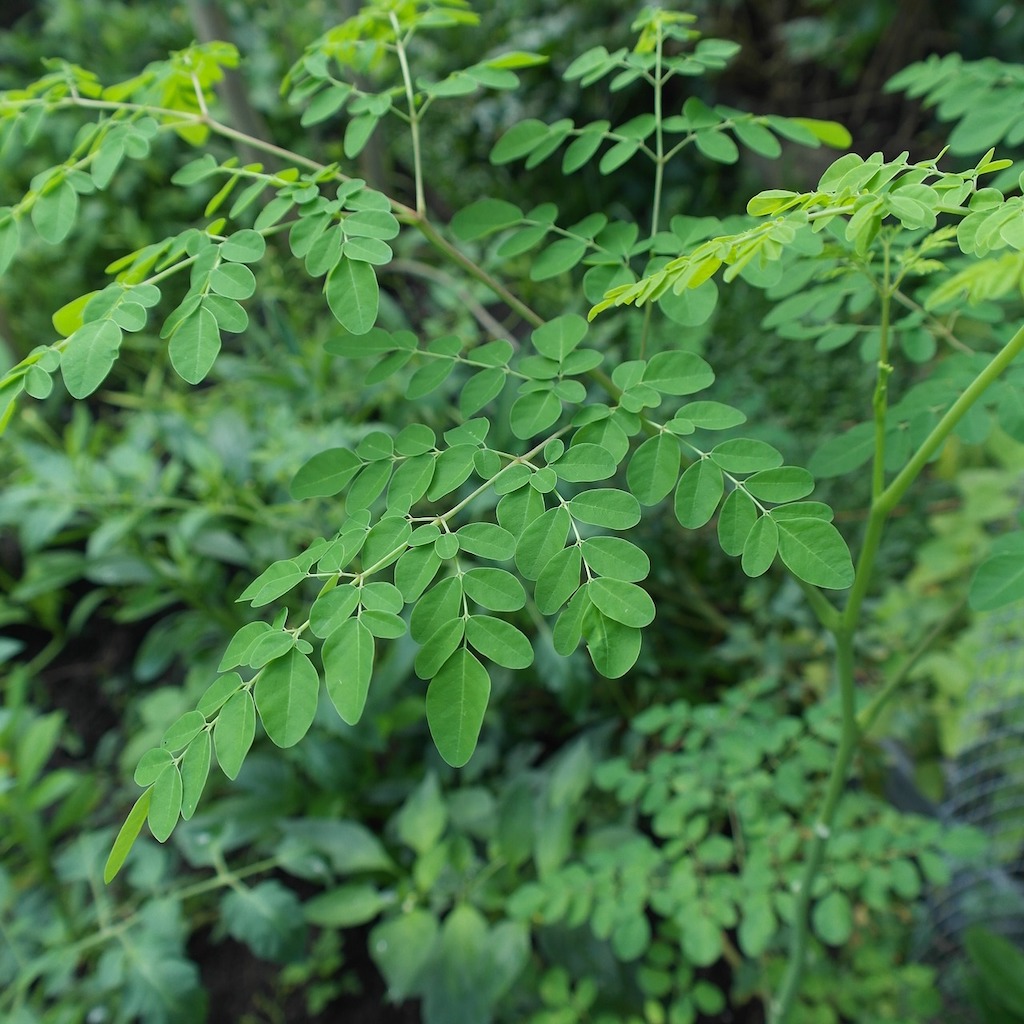
Plant Profile: Moringa
Plant Profile: Moringa (Moringa oleifera Lam.)
Moringa is a tropical tree that is not very well known outside its native habitat, despite offering multiple gifts for the benefit of mankind.
Habitat:
Moringa has spread from its native habitat in the sub-Himalayan region of India to tropical and subtropical areas around the world. It is now cultivated on many continents. It is highly adaptive and tolerant to even the most inhospitably arid soil conditions. Prolonged cold spells with temperatures falling to below 20 °C are the only conditions it can not tolerate. Its preferred conditions are temperatures between 25°-30 °C and well-draining soil.
Description:
Moringa is a fast-growing subtropical tree native to the Himalayan foothills. In as little as 10 months, it can grow to an astonishing height of three meters – from seed! However, it rarely grows to more than 10 meters in total – a tree of medium stature.
Its feathery leaves and bean-like seed pods give it the appearance of a legume species. But that is not the case. Moringa is the only genus of the Moraginacae family, which comprises 13 species. The pods, which are slightly thickened at one end, are known as ‘drum sticks’. Each pod contains 15-20 winged seeds.
The tree branches freely and produces dark, green feathery tri-pinnate leaves with elliptical leaflets. The flowers grow in bunches of small white or cream-coloured flowers and have a subtle fragrance.
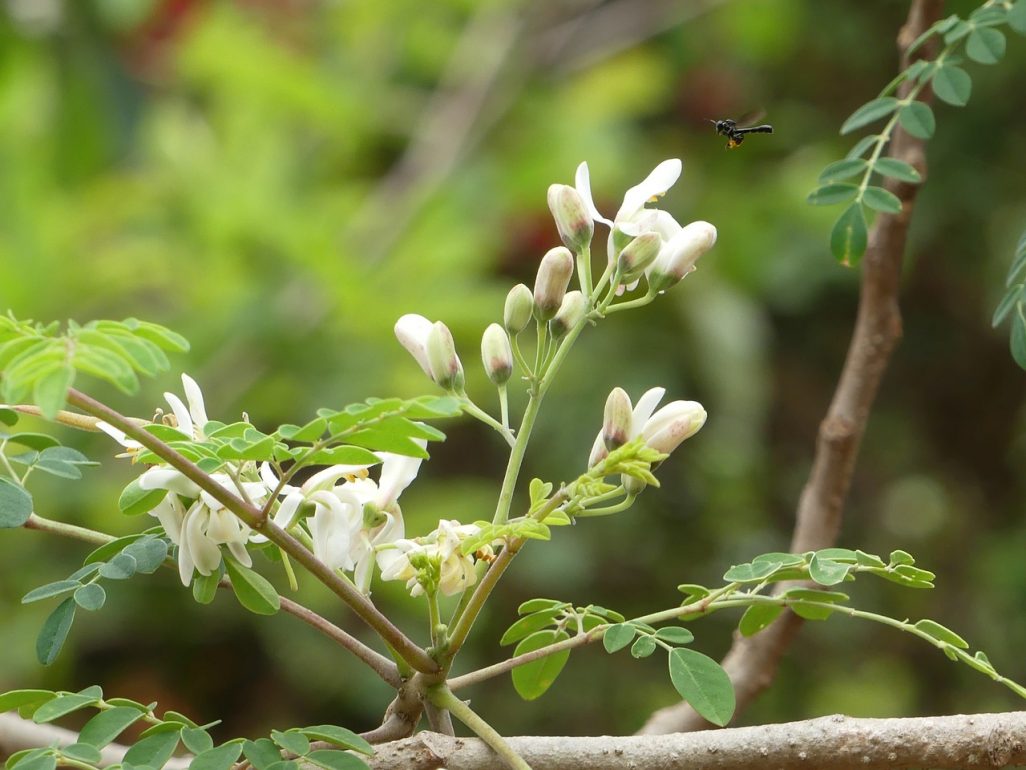 Image by Yaayaa Diallo from Pixabay
Moringa Blossom
History
Moringa is one of the most important and universally useful plants of the tropics.
The entire plant is edible – leaves, seeds, pods, flowers and even the roots – although some experts warn against eating them. (The British called this tree ‘Horseradish root tree’, an allusion to root’s distinct flavour).
Moringa is remarkably rich in essential nutrients such as vitamin A, C and E, calcium, potassium, iron and, perhaps most importantly, protein. It is recommended as a nutritional supplement for pregnant women, nursing mothers, children, and the elderly and infirm. It is one of the few sources of high-quality vegetable protein that contains all essential amino acids.
In India, the young, green and immature pods (the ‘drumsticks’) are a popular ingredient of curries. The seeds yield a high-quality oil used in cooking which is rich in oleic acid. It is very stable, comparable to olive oil in terms of resistance to rancidity and nutritional value. The leaves are the most perishable. Ideally, they should be consumed within a couple of days of harvest. To extend their shelf-life on the market, they need to be bagged and cooled. Alternatively, their nutritional value can be better preserved by drying and powdering them. The powder can then be added as a nutritional supplement to soups, beverages, curries and other foods. But the most miraculous powers are contained within its seeds: Moringa seeds act as ‘flocculants’. They can purify water by causing contaminants to ‘flock together’ and precipitate, i.e. sink to the bottom of the vessel, thus effectively purifying the water. Pharmacologists at Gadja Mada University in Indonesia showed that “one crushed Moringa seed can clear 90% of the total coliform bacteria in a litre of river water within 20 minutes. While an animal study showed that even 2,000 seeds per litre of water had no toxic effects on mice.”
This is powerful and important indeed, especially given the poor water quality in many tropical and subtropical parts of the world. Given that access to clean drinking water is still a problem in many tropical regions, Moringa offers hope. Promoting the planting of Moringa trees could significantly improve water quality, as well as help to boost nutrition in some of the poorest regions of the world.
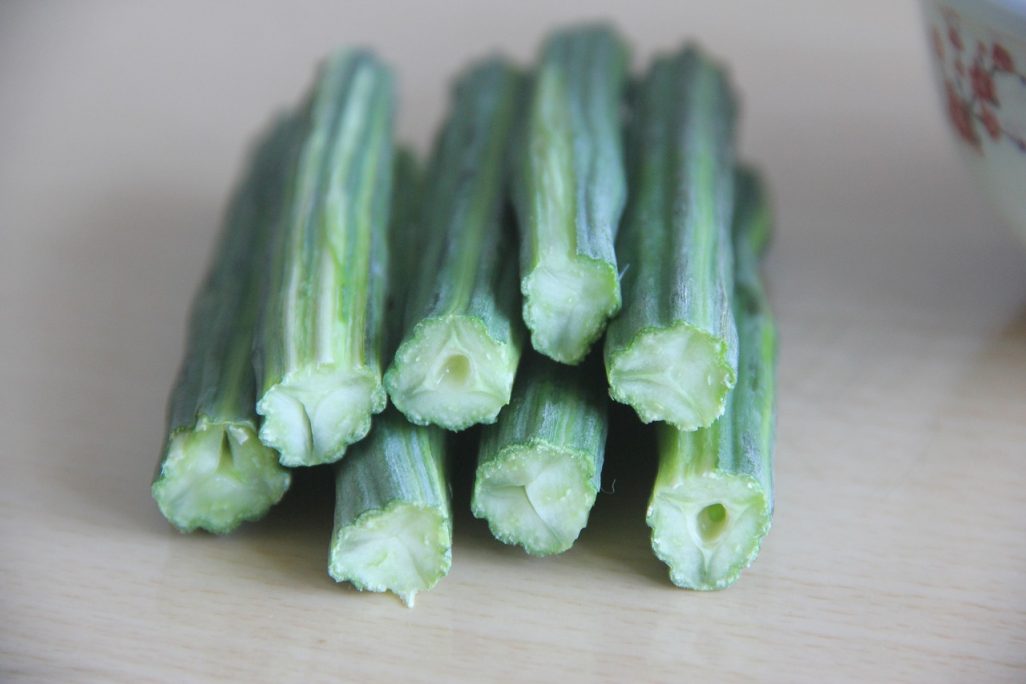
Moringa Drum Sticks Image by S V from Pixabay
Medicinal uses:
Medicinally, Moringa is primarily used to address problems arising from malnutrition. It has a tonic effect on the gastric system and can cure diarrhoea. Thanks to its high vitamin A content, it is a great immune system booster. Vitamin A also helps alleviate visual problems, such as night blindness and xerophthalmia.
Despite its impressive nutritional profile, Moringa can not cure severe malnutrition. The body can no longer process iron, protein or fat once severe physiological abnormalities have been triggered (e.g. infections, impaired liver and intestinal function, imbalance of electrolytes and related problems). However, Moringa is the best available ally to prevent such severe cases and correct mild and moderate ones.
Moringa can also reduce blood sugar levels and thus help control diabetes and high blood pressure. Furthermore, it is said to be helpful in the treatment of respiratory problems, tuberculosis and malaria.
The raw seed pods act on the liver and are used as an anthelminthic (deworming) agent.
The seed oil contains antibiotic and anti-inflammatory compounds. It is used in the treatment of bacterial and fungal skin conditions. Topically, it can be applied to aching joints.
Recent research suggests that Moringa may be effective against certain kinds of cancer, particularly skin cancer. Traditional healers have long used Moringa for this purpose, but further studies are needed to evaluate and verify these traditional uses. They also claim that it to be an excellent nutrient to prevent cancer.
It is easy to add Moringa to the diet, and almost anybody could benefit from it. But above all, it should be used to improve the conditions of those who live in extreme poverty. Moringa should be planted in every available patch of public land to make it accessible to all.
Lead image by Iskandar Ab. Rashid from Pixabay
More articles:
No Results Found
The page you requested could not be found. Try refining your search, or use the navigation above to locate the post.